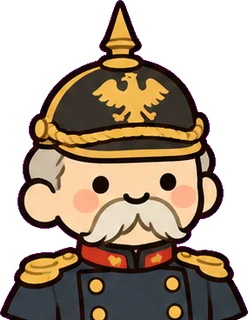
German chancellor · 1815–1898
Otto von Bismarck Political views on the 12 axes
Unified Germany and created the first state pensions and health insurance, building a strong state that looked after its workers.
Read more on WikipediaAbout Otto von Bismarck
Otto von Bismarck (1815–1898) was prime minister of Prussia and the first chancellor of the German Empire. Through three short wars between 1864 and 1871 he united the German states under the Prussian king. At home he fought the Catholic Church and the socialists, while introducing health insurance, accident insurance and old-age pensions, the first national social insurance in the world. Admirers see a master of realist diplomacy who kept Europe at peace for two decades; critics point to his use of war, censorship and pressure on minorities.
Where Otto von Bismarck stands
Our estimate from their writing and record. Axes they took no clear view on are left out.
Unitary
The empire he built kept its states and their kings, but real power sat with Prussia and the chancellor in Berlin.
Oligarchy
Accepted a parliament elected by all adult men, but kept real power with the emperor and his ministers rather than the voters.
Authoritarian
Passed the Anti-Socialist Laws, restricted the press and fought the Catholic Church in the Kulturkampf.
Nationalist
His politics served German unity and national power; alliances were tools for that, not goals in themselves.
Militarist
Used war deliberately to unite Germany and said that the great questions of the day are decided by 'iron and blood'.
Protectionist
Turned to high tariffs on grain and industrial goods in 1879 to protect German farmers and industry.
Mixed Economic
Introduced health, accident and old-age insurance for workers, partly to win them away from socialism.
Balanced
Supported state social insurance and tariffs, and brought the Prussian railways under state ownership.
Moderate
A devout Lutheran who still fought the political power of the Catholic Church, so he lands near the middle.
Traditionalist
A conservative Prussian landowner who defended monarchy, the nobility and the established social order.
Monoculturalist
Pressed Poles and other minorities to adopt German language and culture, and in 1885 expelled Poles without German citizenship.
Technological
Backed railways, industry and modern state administration as sources of national strength.
Close in thought

Famous political figures from Germany
 Karl MarxPhilosopher and revolutionary
 Rosa LuxemburgSocialist theorist
 Angela MerkelChancellor of Germany (2005–2021)
Ideologies closest to Otto von Bismarck
Compared on economy, power, diplomacy and culture, the four axes every ideology is defined on.
- State Socialism76% match
- Conservatism74% match
Sources and further reading
- Lebenslauf · Otto-von-Bismarck-Stiftung
- Otto von Bismarck: Sein Leben, seine Politik · Otto-von-Bismarck-Stiftung
Placements are our own estimates from these sources. Last reviewed Nov 11, 2026. Spotted a mistake? Editorial policy
Questions, answered
What are Otto von Bismarck's political views on the 12 axes?
Unified Germany and created the first state pensions and health insurance, building a strong state that looked after its workers. Where Otto von Bismarck took a clear view. Structure: Unitary; Representation: Oligarchy; Power: Authoritarian; Diplomacy: Nationalist; Military: Militarist; Trade: Protectionist; Economy: Mixed Economic; Control: Balanced; Religion: Moderate; Culture: Traditionalist; Immigration: Monoculturalist; Technology: Technological.
Which ideology is closest to Otto von Bismarck?
State Socialism (76% match), then Conservatism (74% match). Compared on economy, power, diplomacy and culture.
How are Otto von Bismarck's positions estimated?
They are our editorial estimates from Otto von Bismarck's writing and record, from 0 to 100 on each axis. Axes they took no clear view on are left out.
How close are my views to Otto von Bismarck's?
Take the free 12 Axes test. Your result names the famous political figures closest to you, each with a match percentage.
How close are you to Otto von Bismarck?
Take the test and see which famous political figures think most like you.
Take the 12 Axes testWhat it measures and how to start: political test