
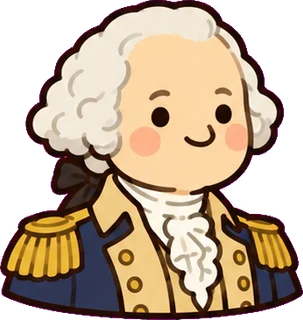
First US president · 1732–1799
George Washington Political views on the 12 axes
Led the Continental Army to victory over Britain, presided over the Constitutional Convention and set the precedent of stepping down after two terms.
Read more on WikipediaAbout George Washington
George Washington (1732–1799) was a Virginia planter who commanded the Continental Army in the American Revolutionary War, winning independence from Britain with the victory at Yorktown in 1781. He presided over the Constitutional Convention in 1787 and served as the first president of the United States from 1789 to 1797. He stepped down after two terms and warned against factions and foreign alliances in his Farewell Address. Supporters credit him with founding a republic by giving up power twice; critics point out that he held hundreds of people in slavery.
Where George Washington stands
Our estimate from their writing and record. Axes they took no clear view on are left out.
Centrist
Backed the 1787 Constitution to give the national government more power than under the weak Articles of Confederation, while states kept wide authority.
Representative Democracy
Gave up his army command in 1783 and refused a third term in 1796, setting the precedent of a peaceful handover of power.
Centrist
Sent about 13,000 militia to end the Whiskey Rebellion against federal taxes, but also signed the Bill of Rights into law, a mild lean toward Security.
Anti-Interventionist
Issued the Neutrality Proclamation of 1793 and in his Farewell Address warned the nation to steer clear of permanent alliances with foreign powers.
Military-Focused
A career soldier who led the Revolutionary army and in 1794 rode out with militia to put down the Whiskey Rebellion, though he sought peace abroad.
Moderate
Signed the Tariff Act of 1789, which taxed imports to fund the government and offered some protection to American manufacturing.
Economic Liberal
A wealthy landowner who backed Hamilton's plans for public credit and commerce; he held people in slavery, freeing them only in his will.
Balanced
Signed Hamilton's national bank into law in 1791 and the federal assumption of state debts, but kept government small, landing near the middle.
Moderate
An Anglican who often spoke of Providence, yet his 1790 letter to the Touro Synagogue promised Jews full religious liberty, placing him near the middle.
Conservative
A member of the Virginia gentry who valued order, propriety and inherited social ranks, leaning toward Traditional despite leading a revolution.
Neutral
Signed the first Patent Act in 1790 and experimented with new crops and farming methods at Mount Vernon, a mild lean toward Technology.
Close in thought





Famous political figures from United States
United States on the 12 axes →




Ideologies closest to George Washington
Compared on economy, power, diplomacy and culture, the four axes every ideology is defined on.
Questions, answered
What are George Washington's political views on the 12 axes?
Led the Continental Army to victory over Britain, presided over the Constitutional Convention and set the precedent of stepping down after two terms. Where George Washington took a clear view. Structure: Centrist; Representation: Representative Democracy; Power: Centrist; Diplomacy: Anti-Interventionist; Military: Military-Focused; Trade: Moderate; Economy: Economic Liberal; Control: Balanced; Religion: Moderate; Culture: Conservative; Technology: Neutral.
Which ideology is closest to George Washington?
Moderate Conservatism (91% match), then Classical Liberalism (80% match). Compared on economy, power, diplomacy and culture.
How are George Washington's positions estimated?
They are our editorial estimates from George Washington's writing and record, from 0 to 100 on each axis. Axes they took no clear view on are left out.
How close are my views to George Washington's?
Take the free 12 Axes test. Your result names the famous political figures closest to you, each with a match percentage.
How close are you to George Washington?
Take the test and see which famous political figures think most like you.
Take the 12 Axes testWhat it measures and how to start: political test