
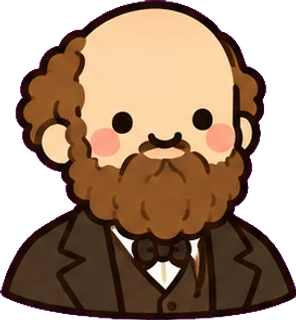
Economist and reformer · 1839–1897
Henry George Political views on the 12 axes
Proposed a single tax on land values to share the wealth of the land with everyone, alongside free trade.
Read more on WikipediaAbout Henry George
Henry George (1839–1897) was an American journalist and economist. In Progress and Poverty (1879), one of the century's best-selling books, he asked why poverty deepened as wealth grew, and blamed private gains from rising land values. His answer was a single tax on land values to replace taxes on work and trade. He ran for mayor of New York in 1886, finishing second, and died during a second campaign in 1897. Supporters credit him with a fair tax that rewards work and curbs speculation; critics argue a land tax alone could not fund government and would unsettle property rights.
Where Henry George stands
Our estimate from their writing and record. Axes they took no clear view on are left out.
Centrist
Wrote little about the balance between states and federal government, and his land tax could work at any level, so he lands in the middle.
Direct Democracy
Campaigned for the secret ballot and took his ideas to the voters, running for mayor of New York twice.
Liberal
Wanted to free labour and enterprise from taxes and state interference and leave only land values to be taxed, a lean toward Freedom.
Internationalism
Saw the earth as the common heritage of all people and argued that free exchange should unite nations rather than divide them.
Non-Aggressive
Argued that tariffs and grabs for land breed conflict and that free trade would bind nations in peace, a lean toward Pacifist.
Global Economy
In Protection or Free Trade (1886) he called for abolishing all tariffs, the strongest Globalist stance.
Socialist
Held that the value of land belongs to the whole community and should be collected for all, a clear lean toward Equality.
Balanced
Trusted free markets in goods and labour, though he wanted public ownership of natural monopolies such as railways and telegraphs.
Moderate
A man of personal faith who closed Progress and Poverty on a spiritual note, but argued his case on economic grounds; a slight lean toward Secular.
Progressive
Challenged Gilded Age inequality and inspired many reformers of the Progressive Era, a clear lean toward Progressive.
Neutral
Welcomed new machines and productivity, but asked why progress left so many poor; a slight lean toward Technology.
Close in thought



Famous political figures from United States
 Martin Luther King Jr.Civil rights leader
 John RawlsPolitical philosopher
 Franklin D. RooseveltUS president
 Thomas PaineRevolutionary pamphleteer
 Thomas JeffersonUS president
 Milton FriedmanEconomist
Ideologies closest to Henry George
Compared on economy, power, diplomacy and culture, the four axes every ideology is defined on.
Sources and further reading
- Henry George · Encyclopaedia Britannica
- Progress and Poverty, Volumes I and II by Henry George · Project Gutenberg
Placements are our own estimates from these sources. Last reviewed Nov 11, 2026. Spotted a mistake? Editorial policy
Questions, answered
What are Henry George's political views on the 12 axes?
Proposed a single tax on land values to share the wealth of the land with everyone, alongside free trade. Where Henry George took a clear view. Structure: Centrist; Representation: Direct Democracy; Power: Liberal; Diplomacy: Internationalism; Military: Non-Aggressive; Trade: Global Economy; Economy: Socialist; Control: Balanced; Religion: Moderate; Culture: Progressive; Technology: Neutral.
Which ideology is closest to Henry George?
Social Liberalism (81% match), then Progressivism (80% match). Compared on economy, power, diplomacy and culture.
How are Henry George's positions estimated?
They are our editorial estimates from Henry George's writing and record, from 0 to 100 on each axis. Axes they took no clear view on are left out.
How close are my views to Henry George's?
Take the free 12 Axes test. Your result names the famous political figures closest to you, each with a match percentage.
How close are you to Henry George?
Take the test and see which famous political figures think most like you.
Take the 12 Axes testWhat it measures and how to start: political test