
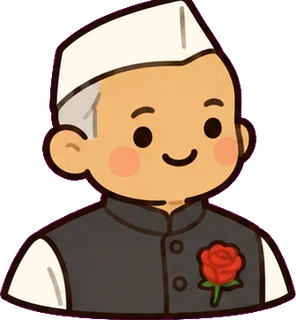
First prime minister of India · 1889–1964
Jawaharlal Nehru Political views on the 12 axes
Led India from independence in 1947, building a secular democracy with a planned, state-led economy and a foreign policy of non-alignment.
Read more on WikipediaAbout Jawaharlal Nehru
Jawaharlal Nehru (1889–1964) was a leader of the Indian independence movement alongside Mahatma Gandhi and served as India's first prime minister from 1947 until his death. He held the first general elections in 1951–52, launched Five-Year Plans for a state-led economy, and founded institutions such as the Indian Institutes of Technology. Abroad, he helped create the Non-Aligned Movement. Supporters credit him with building a secular, democratic India that held together; critics fault his planned economy for slow growth and his China policy for the defeat of 1962.
Where Jawaharlal Nehru stands
Our estimate from their writing and record. Axes they took no clear view on are left out.
Unitary
The 1950 constitution his government shaped gives the centre strong powers over the states, though he accepted new states drawn on language lines in 1956.
Direct Democracy
Built India as a parliamentary democracy, holding the first general elections on universal adult suffrage in 1951–52 and two more while in office.
Centrist
Protected a free press and courts, but passed the Preventive Detention Act in 1950 and the First Amendment of 1951 restricting speech, landing in the middle.
Internationalism
Helped found the Non-Aligned Movement after the Bandung Conference of 1955 and championed the United Nations and decolonisation worldwide.
Non-Aggressive
Promoted the Panchsheel principles of peaceful coexistence in 1954, though he sent troops into Goa in 1961 and fought China in 1962.
Protectionist
Pursued self-reliance through import substitution, high tariffs and licences that shielded Indian industry from foreign competition.
Socialist
Aimed at a 'socialistic pattern of society', backing the abolition of the zamindari landlord system and state ownership of key industries.
Interventionism
Set up the Planning Commission in 1950 and launched Five-Year Plans that put heavy industry in state hands, a strong pull toward Planned.
Atheist
Insisted India be a secular state that favoured no faith, and pushed through the Hindu Code Bills to reform Hindu personal law.
Culturally Left
The Hindu Code Bills of the mid-1950s gave Hindu women rights to divorce and inheritance, a clear lean toward Progressive.
Polyculturalist
Spoke of unity in diversity, protected separate personal laws for religious minorities and accepted language-based states, leaning toward Multiculturalist.
Accelerationist
Founded the IITs and the Atomic Energy Commission and called large dams the 'temples of modern India'.
Close in thought






Famous political figures from India
India on the 12 axes →
Ideologies closest to Jawaharlal Nehru
Compared on economy, power, diplomacy and culture, the four axes every ideology is defined on.
Questions, answered
What are Jawaharlal Nehru's political views on the 12 axes?
Led India from independence in 1947, building a secular democracy with a planned, state-led economy and a foreign policy of non-alignment. Where Jawaharlal Nehru took a clear view. Structure: Unitary; Representation: Direct Democracy; Power: Centrist; Diplomacy: Internationalism; Military: Non-Aggressive; Trade: Protectionist; Economy: Socialist; Control: Interventionism; Religion: Atheist; Culture: Culturally Left; Immigration: Polyculturalist; Technology: Accelerationist.
Which ideology is closest to Jawaharlal Nehru?
Social Democracy (81% match), then Democratic Socialism (78% match). Compared on economy, power, diplomacy and culture.
How are Jawaharlal Nehru's positions estimated?
They are our editorial estimates from Jawaharlal Nehru's writing and record, from 0 to 100 on each axis. Axes they took no clear view on are left out.
How close are my views to Jawaharlal Nehru's?
Take the free 12 Axes test. Your result names the famous political figures closest to you, each with a match percentage.
How close are you to Jawaharlal Nehru?
Take the test and see which famous political figures think most like you.
Take the 12 Axes testWhat it measures and how to start: political test