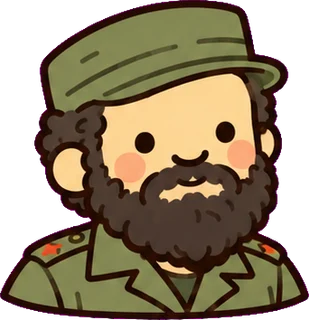
Leader of Cuba · 1926–2016
Fidel Castro Political views on the 12 axes
Led the 1959 Cuban Revolution and governed Cuba for almost fifty years as a one-party socialist state allied with the Soviet Union.
Read more on WikipediaAbout Fidel Castro
Fidel Castro (1926–2016) led the guerrilla war that overthrew Fulgencio Batista in January 1959 and governed Cuba until 2008, first as prime minister and from 1976 as president. He nationalised land and industry, declared the revolution socialist in 1961, survived the US-backed Bay of Pigs invasion that year and allied Cuba with the Soviet Union, which led to the 1962 missile crisis. His government made schooling and healthcare free while banning opposition parties. Supporters credit him with literacy, public health and standing up to the United States; critics point to executions, political prisoners and the exile of many Cubans.
Where Fidel Castro stands
Our estimate from their writing and record. Axes they took no clear view on are left out.
Centralized
Ran Cuba from Havana as a single centralised state, where provinces and local assemblies carried out national plans rather than setting their own course.
Oligarchy
Banned rival parties, never held a competitive national election and wrote the Communist Party into the 1976 constitution as the leading force of state and society.
Authoritarian
Revolutionary tribunals executed hundreds of Batista-era officials in 1959, and his state jailed dissidents and controlled all media, a strong pull toward Security.
Non-Interventionist
Sent troops to Angola from 1975 and doctors around the world, yet framed his politics around Cuban sovereignty against the United States, so he sits near the middle.
Military-Focused
Came to power through guerrilla war, built large armed forces and popular militias, and sent combat troops to fight in Angola and Ethiopia.
Protectionist
The state held a monopoly on foreign trade, and from 1972 Cuba traded mainly inside the Soviet-led Comecon bloc rather than on open markets.
Communist
Nationalised land, banks and industry, rationed basic goods and made education and healthcare free, putting equal living standards before private wealth.
Planned Economy
Replaced markets with central state planning, and in the 1968 Revolutionary Offensive nationalised even small shops and street businesses.
Atheist
Under him Cuba was officially atheist until 1992 and curbed the churches, though he later eased those limits and welcomed three papal visits.
Moderate
Ran a mass literacy campaign and drew women into education and work, yet in the 1960s sent gay men to labour camps, so he lands mid-way.
Neutral
Invested in medical research and built a biotechnology industry from the 1980s, a modest lean toward Technology in a country short of resources.
Close in thought

Ideologies closest to Fidel Castro
Compared on economy, power, diplomacy and culture, the four axes every ideology is defined on.
Questions, answered
What are Fidel Castro's political views on the 12 axes?
Led the 1959 Cuban Revolution and governed Cuba for almost fifty years as a one-party socialist state allied with the Soviet Union. Where Fidel Castro took a clear view. Structure: Centralized; Representation: Oligarchy; Power: Authoritarian; Diplomacy: Non-Interventionist; Military: Military-Focused; Trade: Protectionist; Economy: Communist; Control: Planned Economy; Religion: Atheist; Culture: Moderate; Technology: Neutral.
Which ideology is closest to Fidel Castro?
State Socialism (82% match), then Marxism (74% match). Compared on economy, power, diplomacy and culture.
How are Fidel Castro's positions estimated?
They are our editorial estimates from Fidel Castro's writing and record, from 0 to 100 on each axis. Axes they took no clear view on are left out.
How close are my views to Fidel Castro's?
Take the free 12 Axes test. Your result names the famous political figures closest to you, each with a match percentage.
How close are you to Fidel Castro?
Take the test and see which famous political figures think most like you.
Take the 12 Axes testWhat it measures and how to start: political test