
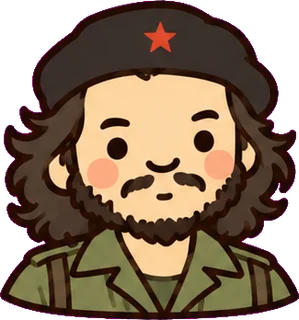
Marxist revolutionary · 1928–1967
Che Guevara Political views on the 12 axes
Argentine doctor turned guerrilla who fought in the Cuban Revolution, helped run Cuba's economy and died trying to spread armed revolution to Bolivia.
Read more on WikipediaAbout Che Guevara
Ernesto 'Che' Guevara (1928–1967) was an Argentine doctor who joined Fidel Castro's rebels in 1956 and became one of the commanders of the Cuban Revolution. After 1959 he oversaw the revolutionary tribunals at La Cabaña fortress, headed the national bank and served as minister of industries. He left Cuba in 1965 to lead guerrillas in the Congo and then Bolivia, where the Bolivian army captured and executed him in October 1967. Supporters see a selfless revolutionary who gave his life for the poor against imperialism; critics point to the executions he approved and his faith in armed struggle.
Where Che Guevara stands
Our estimate from their writing and record. Axes they took no clear view on are left out.
Centralized
As minister of industries he ran the nationalised firms from one central ministry in Havana and opposed giving enterprises their own financial autonomy.
Oligarchy
Saw a vanguard party and armed revolution, not elections, as the road to socialism, and wanted the revolution to reshape people from above.
Authoritarian
Commanded La Cabaña in 1959, where revolutionary tribunals tried and executed officials of the old government, a strong pull toward Security.
Internationalism
Fought in Cuba, the Congo and Bolivia and in 1967 called for 'two, three, many Vietnams', a strong stance for world revolution over any one nation.
Militarist
His book Guerrilla Warfare (1960) argued that small armed bands could start a revolution, and he spent his last years leading guerrillas abroad.
Limited Trade
Pushed new industry to replace imports and end dependence on sugar, and in Algiers in 1965 criticised even socialist countries for unequal trade.
Communist
Wanted to abolish private property and money incentives, aiming for a society where people worked for the common good rather than personal gain.
Planned Economy
Ran Cuban industry through a budget-financed central plan and argued for moral over material incentives in the economic debate of 1963–1964.
Atheist
A convinced Marxist and atheist whose writings on the 'new man' placed the source of morality in the revolution, not in religious faith.
Moderate
His essay Socialism and Man in Cuba (1965) called for a 'new man' with new values, a modest lean toward Progressive in culture.
Neutral
Promoted industrialisation and technical training, but treated technology as a tool of the revolution rather than a goal, so he lands near the middle.
Close in thought

Famous political figures from Argentina
Argentina on the 12 axes →



Ideologies closest to Che Guevara
Compared on economy, power, diplomacy and culture, the four axes every ideology is defined on.
Questions, answered
What are Che Guevara's political views on the 12 axes?
Argentine doctor turned guerrilla who fought in the Cuban Revolution, helped run Cuba's economy and died trying to spread armed revolution to Bolivia. Where Che Guevara took a clear view. Structure: Centralized; Representation: Oligarchy; Power: Authoritarian; Diplomacy: Internationalism; Military: Militarist; Trade: Limited Trade; Economy: Communist; Control: Planned Economy; Religion: Atheist; Culture: Moderate; Technology: Neutral.
Which ideology is closest to Che Guevara?
Marxism (75% match), then Revolutionary Socialism (60% match). Compared on economy, power, diplomacy and culture.
How are Che Guevara's positions estimated?
They are our editorial estimates from Che Guevara's writing and record, from 0 to 100 on each axis. Axes they took no clear view on are left out.
How close are my views to Che Guevara's?
Take the free 12 Axes test. Your result names the famous political figures closest to you, each with a match percentage.
How close are you to Che Guevara?
Take the test and see which famous political figures think most like you.
Take the 12 Axes testWhat it measures and how to start: political test